My early challenges with recycle units in process simulations
My first encounter with process simulations was 20 years ago during a summer job. I was given the task to implement a model of a gas-compression train of an oil field in a commercial process simulation software. Everything went well until I encountered a stream going backwards in the process, making a “loop”.
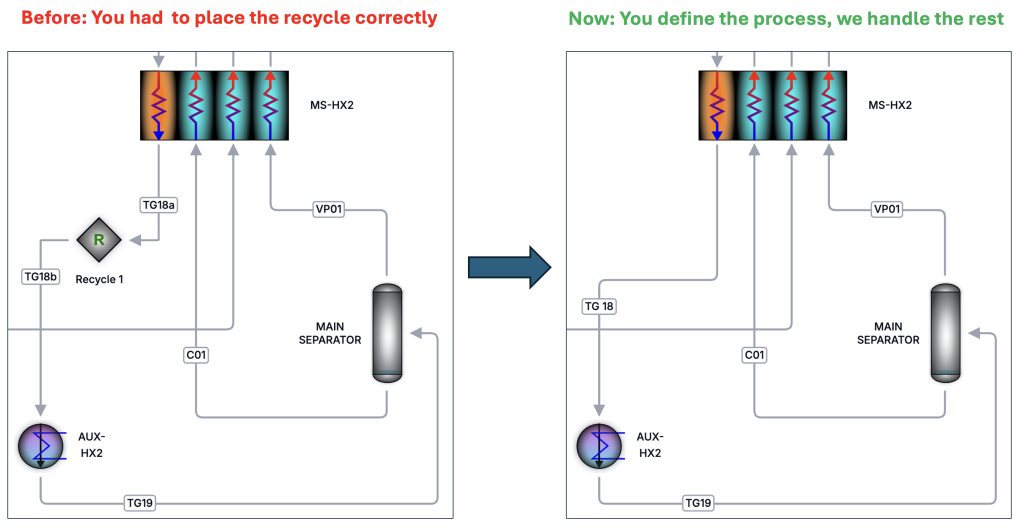
What I didn’t know was that solving such processes requires me to correctly place something called a “recycle unit”, also called just “recycle”. The recycle is the square with the green R in the illustration below. In addition to find the correct location for the recycle, I also had to provide it with realistic initial conditions and tolerance.
No matter what I tried, and no matter where I placed the recycle, the flowsheet would not converge. Then a fourth-year chemical engineering student stepped in. He had learned exactly where to place recycles for this particular process in a university course, and the simulation converged immediately. It felt like black magic to me (and still sometime does).
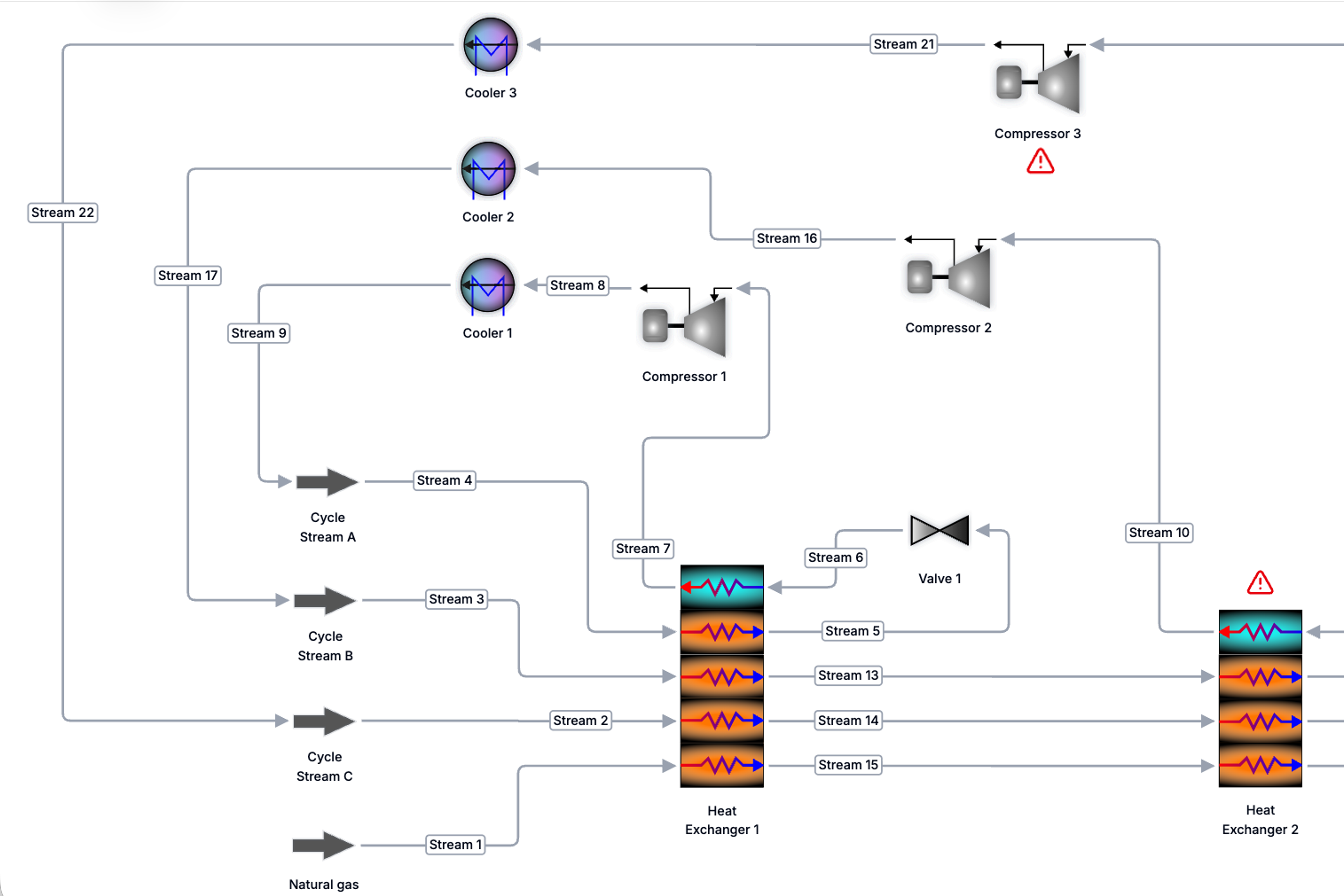
In a simple top-side gas processing plant, placing the recycle is manageable. In complex and integrated processes such as the CO2 liquefaction process shown below, it is a much more challenging job. To be honest, I struggled several hours to find the right location for the recycle to make the flowsheet converge and at first, I didn’t even know whether I should use one or two recycles.
Managing recycle units is arguably the main reason why setting up advanced process simulations is still a specialist job, and why entire university courses are dedicated to solving these problems. But does it need to be this way?
The recycle unit does not exist in real process plants
Here is the truth: there is no such thing as a recycle unit in a real process plant.
Recycle units exist only in process simulation software. They are not physical equipment, but artifacts of old numerical algorithms. When the first commercial process simulators were developed 40 years ago based on sequential-modular solvers, it made sense to outsource part of the numerical problem to the user. An un-converged simulation was unacceptable (and still is), and manual control improved robustness. But that historical compromise has become a burden.
Ideally, engineers should specify what the process is and how to improve it, not how the numerical solver should solve it.
Recycle units are now optional
In TP-Process, recycle units are now optional.
For users who want full manual control, recycle units remain available. You can place them anywhere in a loop and manage convergence exactly as you are used to.
For everyone else, the process is fully specified from the process flow diagram, no recycle units are required. Convergence is our responsibility, not yours.
If a process does not converge with reasonable input values, that is not a modeling failure, it is a numerical issue, and it’s our responsibility to fix it.