The most accurate Equations of State available for many fluids and fluid mixtures
Multiparameter equations of state (EoS) have been around for a while. For decades, the National Institute of Standards and Technology (NIST) in the US and several prominent research groups around the world have developed highly accurate EoS with experimental accuracy for 150+ pure fluids and mixtures. Examples include GERG-2004, GERG-2008, EOS-LNG and EoS-CG. These EoS have unparalleled accuracy in the regions where experimental data are available. Better accuracy lowers the chances of undesired problems and improves the design margin, which means lower cost.
In process simulations, multiparameter EoS are usually reasonably robust when used for single-component fluids such as water (IAPWS), CO2 (Span Wagner) and hydrogen (Leachman). For fluid mixtures however, at near critical conditions or for many mixtures with water, calculations have so far been slow and numerically fragile. We have not been able to find any commercial software that so far has been able to overcome these challenges.
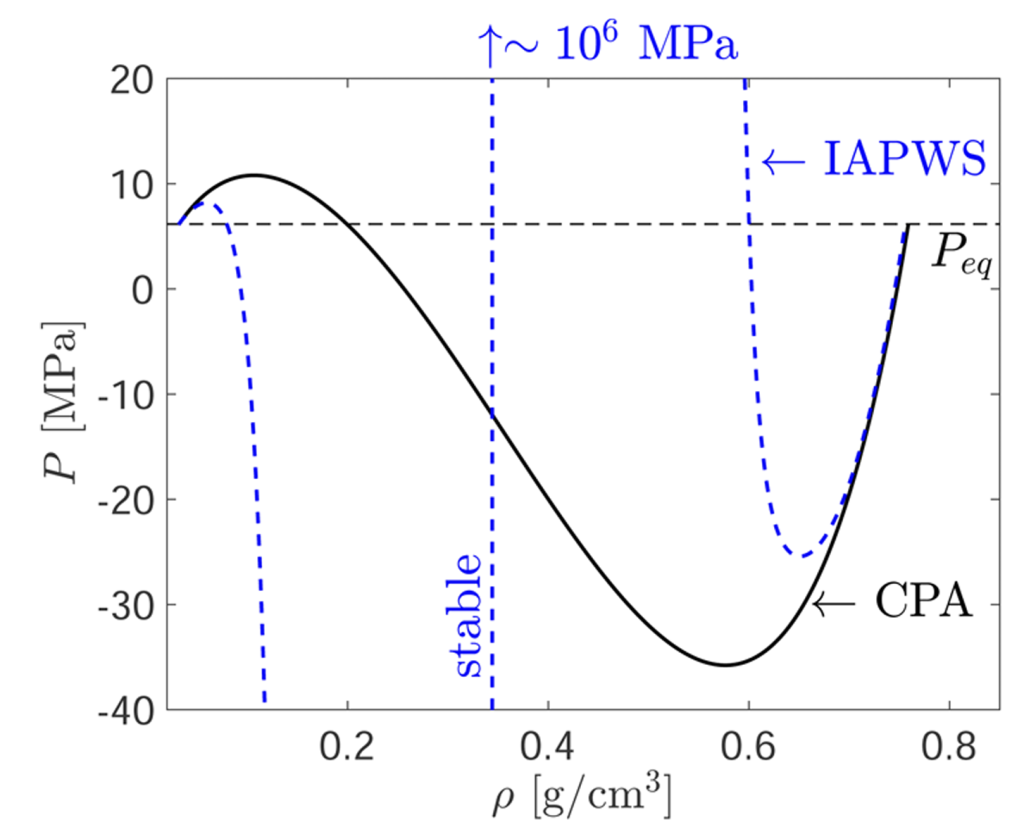
The high accuracy of multiparameter EoS is not without compromises. One of the major challenges are unphysical density roots and something which is called multiple Maxwell loops. The diverging Maxwell loop for the IAPWS EoS for water is shown in the illustration below.
From a physical perspective, this loop introduces a stable homogeneous phase in a region where water is really two phases, gas and liquid. Imagine if you have a mixture with 10 components, where all of the 10 single component formulations, and maybe also some of the mixture model formulations have similar problems. This is one of the main reasons why multiparameter EoS for mixtures is very difficult to solve sufficiently robustly to be used in process simulations.
If the thermodynamic calculations with the multiparameter EoS fail for one state any time in the solution procedure, the process simulation will likely fail to converge, so numerical robustness of the underlying equation of state is essential.
The importance of high accuracy in process design
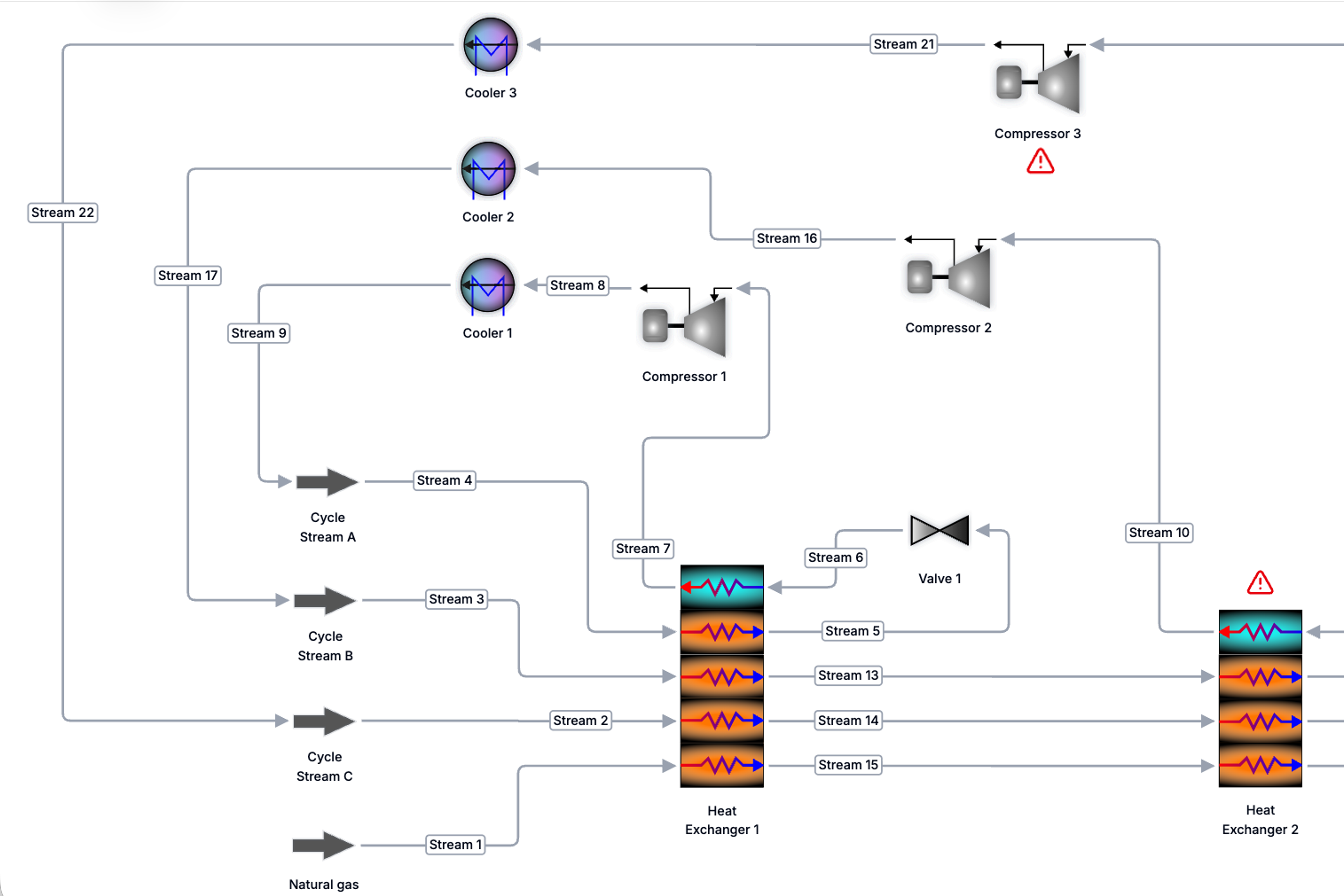
To illustrate the impact thermodynamic assumptions can have on engineering workflows, we will use an example from the PhD thesis of Dr. Bjørn Austbø, where the Peng-Robinson equation of State was used in a process simulation of a triple mixed refrigerant mixed fluid cascade (MFC) Liquefied Natural Gas (LNG) process.
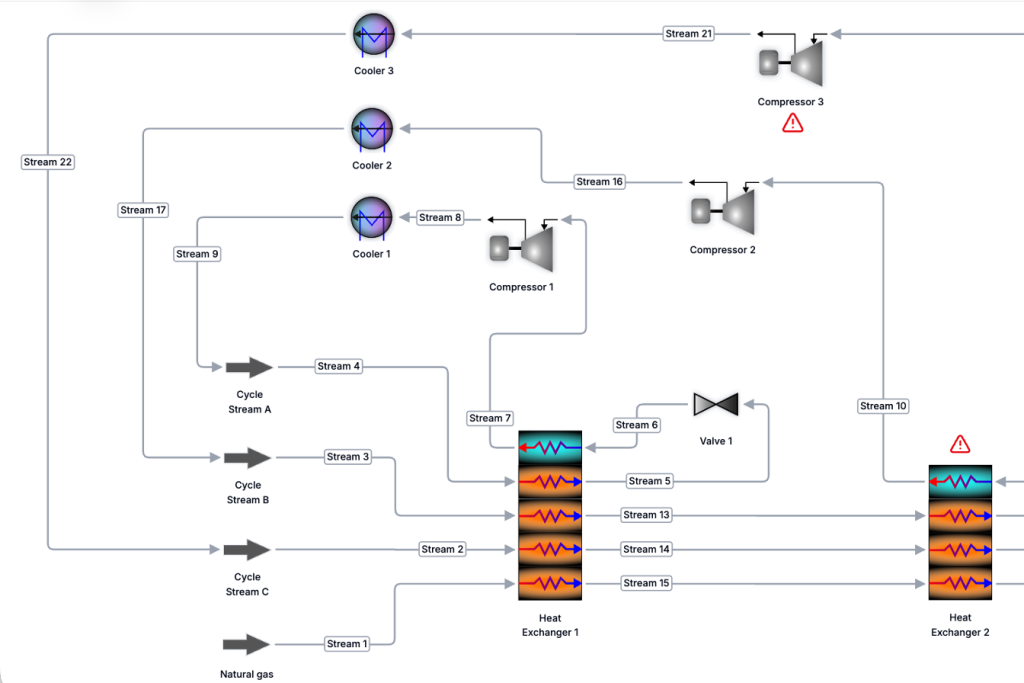
Massflowrates, temperatures, pressure-levels and compositions for the three mixed refrigerants were diligently optimized by Bjørn to achieve a high performance for the process. Following common practice and using the Peng Robinson EoS, the process has an excellent efficiency, and there are no safety issues flagged.
When the same process is re-solved using a highly accurate multiparameter EoS, two major issues appear and show up as two red warning triangles:
- A temperature crossing of 5.2 K in Heat Exchanger 2.
- Liquid entering Compressor 3.
A temperature crossing means that the heat exchanger inlet and outlet conditions are physically impossible. Liquid in the compressor will, in this case, create severe operational and mechanical challenges.
In practice, this means that the process configuration with the specified parameters is no longer feasible.
This example illustrates how thermodynamic assumptions can fundamentally change engineering conclusions.
Robust and fast multiparameter equations of state
For the last year, we have worked extensively on robustifying the numerical algorithms and speeding up our solvers to make it feasible to simulate full process plants with multiparameter equations of state and complex mixtures, even with water and multiple liquid phases in TP-Process in the cloud.
By introducing extensive automated testing, reformulating key numerical algorithms and improving solver robustness, we have significantly reduced the computational cost and improved the robustness of difficult thermodynamic calculations involving mixtures, pipelines and complex process units.
For several difficult process configurations, simulations that previously required 10+ minutes to solve from scratch can now be solved in seconds. We believe this will fundamentally change how high-accuracy thermodynamics can be used in practical engineering workflows in the coming years.