Hydrogen is a way to store surplus energy from peaks in wind or solar power generation, both for later use and for export. A way to transport or store large amounts of hydrogen as a liquid, which at atmospheric pressure means cooling it down to around 20 K, or -253 degrees Celsius.
One of the peculiarities of hydrogen is that it comes in two versions, ortho-hydrogen and para-hydrogen. Ortho-hydrogen is the high-energy spin state, and para-hydrogen is the low-energy spin state. At low temperatures, hydrogen prefers to be almost entirely para-hydrogen, while at room temperature, the equilibrium concentration has only 25% para-hydrogen.
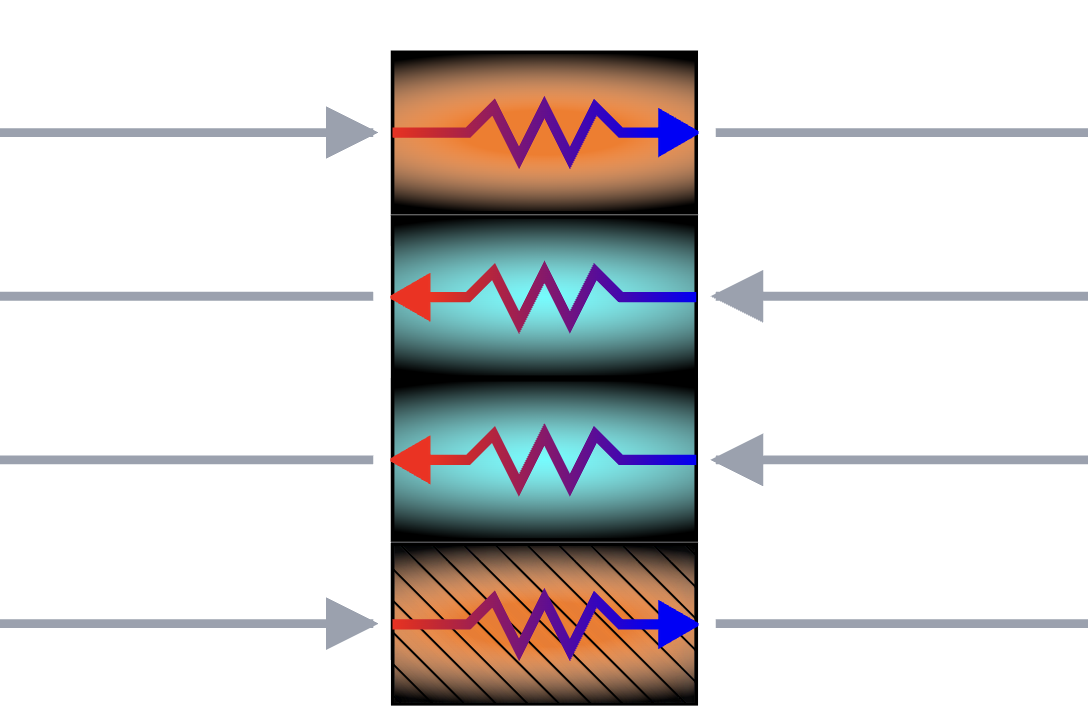
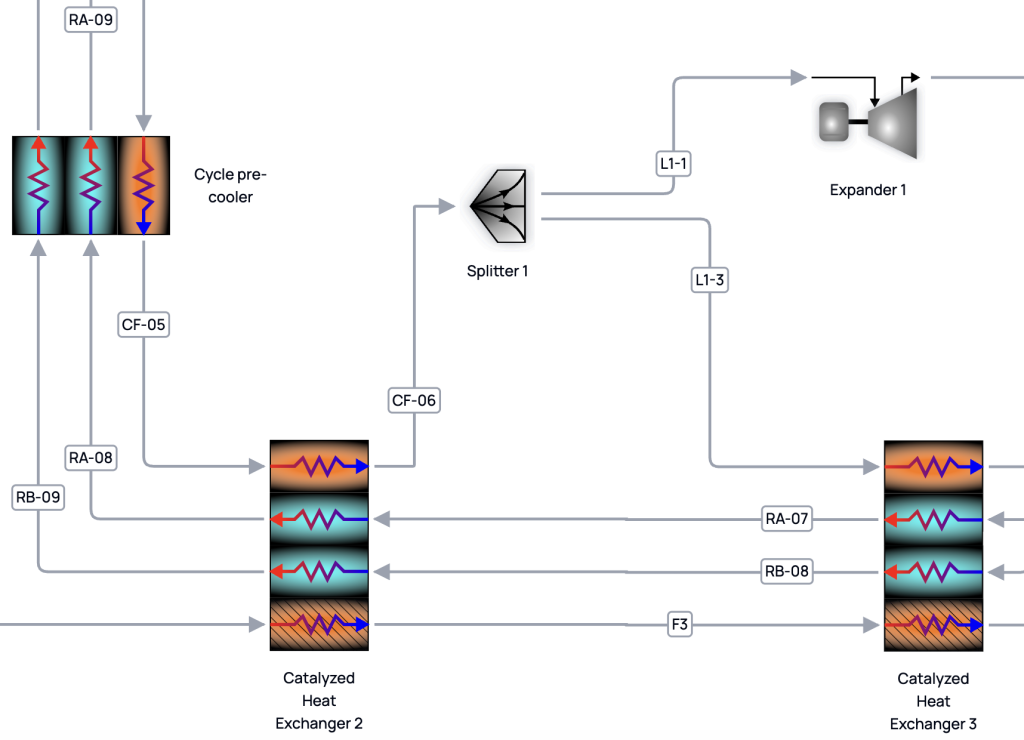
Ortho-para conversion is slow. In hydrogen liquefaction processes, a catalyst is often placed directly inside selected layers of the hydrogen feed channels of the heat exchanger to accelerate the conversion between the ortho and para spin isomers of hydrogen. If this is not done properly, the energy difference between ortho- and para-hydrogen is so large that the exothermic conversion of ortho-hydrogen to para-hydrogen in storage tanks will lead to excessive boil-off.
At low temperatures, the heat of conversion between ortho- and para-hydrogen is substantial, which means that catalyst-filled plate-fin heat exchangers are hybrid units that combine heat transfer and a spin-isomer conversion reaction. In practice, they are neither conventional reactors nor conventional heat exchangers.
To model this correctly, we have developed a dedicated process unit: the reactive heat exchanger. The unit allows reaction only inside catalyst-filled layers, while simultaneously resolving heat transfer across the exchanger. In this blog, we explain why this is necessary, discuss other use cases for the reactive heat exchanger, and outline why more custom units are planned.
Why custom units are essential in modelling hydrogen liquefaction processes
In the absence of dedicated process units, we are forced to make approximations and carry out workarounds that can be both time-consuming and, in some cases, quite inaccurate.
Reactive heat exchangers can be represented as separate reactors and heat exchangers. Membrane modules can be represented as component splitters. These simplifications can sometimes be acceptable, but often they lead to wrong conclusions and eventually an infeasible process design.
The large heat of conversion when ortho-hydrogen converts to para-hydrogen has a significant influence on the temperature profiles and duty of the heat exchangers. In order to arrive at a reasonable process design, the heat of conversion must be accounted for inside the heat exchangers.
A workaround here is the use of the “equilibrium hydrogen” concept, which is a hypothetical fluid where the heat of conversion is baked into an effective heat capacity of the “effective fluid”. This assumes the following:
“The hydrogen always has the equilibrium ortho–para composition.”
This can be a reasonable assumption inside heat exchanger layers where a catalyst is present. But in all other cases, it is simply not correct. When the same fluid is used in valves, compressors, turbines and heat exchanger layers where no catalyst is present, it can introduce large inaccuracies. To overcome this challenge, we have developed the reactive heat exchanger.
In this process unit, a reactive phase equilibrium is solved only in the layers where a catalyst is present, using a mixture of ortho- and para-hydrogen that can deviate from the equilibrium composition in process units where catalyst is not present. The advantage is that the same fluid description can be used throughout the whole process, and the process model becomes a more precise and accurate representation of the real energy and mass balances taking place.
Other use cases
While the reactive heat exchanger has so far been used to successfully simulate hydrogen liquefaction processes, there are also many other potential use cases:
- CO2 methanation: The reaction is strongly exothermic and equilibrium-limited. Distributed heat removal helps control hot spots and maintain favorable reaction temperatures along the equipment.
- Gas heated steam reforming: Reforming reactions are strongly endothermic. Supplying heat continuously along the reactor provide a more realistic representation than separating the heater and reactor into idealized units.
- Methanol synthesis: The reaction is exothermic and equilibrium-limited. Integrated cooling can remove heat where it is generated and maintain a more favorable temperature profile.
- Ammonia cracking: Ammonia decomposition requires heat input at high temperatures. Integrating heat end reactions can make this technology both more practical and energy efficient.
- Reactive power cycles: Here reactions inside of the heat exchangers can potentially increase the efficiency of the power cycle. It’s a very exciting technology for the future that is currently under investigation.reactive heat exchanger:
More custom units planned
Most of the process simulators available today have been developed for the oil and gas industry. We see significant potential in developing custom process units that can serve new applications in the green transition. Examples include data centers, battery packs, solar farms, hydrogen electrolyzers and many more. Stay tuned for more information.