Safety and flow assurance calculations must be performed before a process can be built. Key concerns such as formation of hydrates or acids must be identified and mitigated before the process is considered viable.
There are plenty of examples of unaddressed risks that have ended up as real incidents and even human fatalities. Nobody wants a 200 kg hydrate projectile shooting through their pipeline.
Traditionally, process simulators have offered limited functionality for these phenomena. Some have the possibility to manually check streams for hydrates, but with the same equation of state as the rest of the process (Peng-Robinson). There are several limitations with this approach:
- Peng-Robinson is inaccurate for hydrates, which requires tailored models such as CPA with fine-tuned water parameters.
- You need to manually check all the 514 streams of your process.
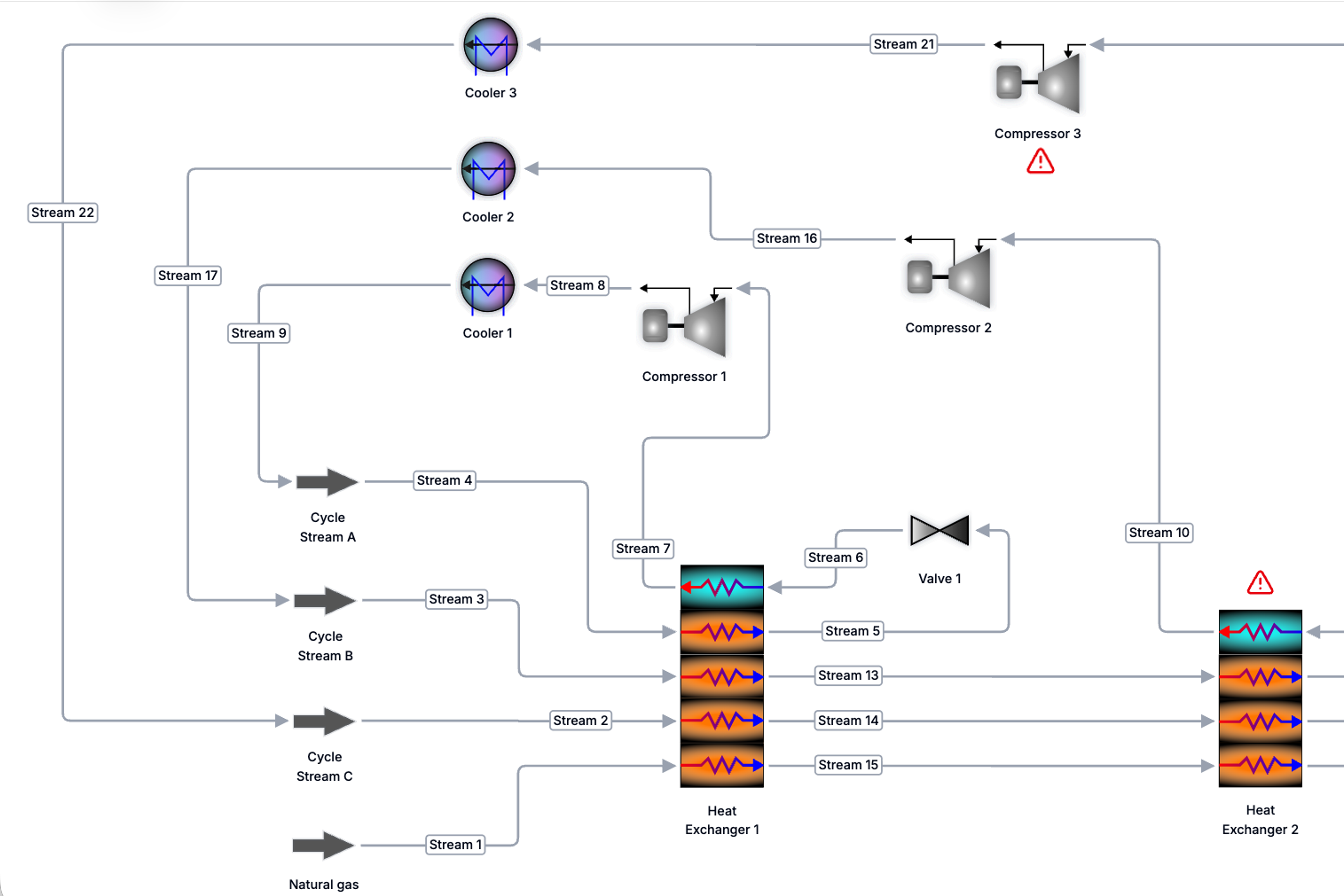
- What about the interior of pipelines, heat exchangers and compressors? The temperature and pressure and phase composition inside of these units can change so much that it’s not enough to check the inlet and outlet streams.
Companies realize that the manual approach outlined above is not good enough, so they often outsource the problem to an external flow assurance specialist. This specialist will still perform stream-by-stream screening, followed by post-processing with dedicated thermodynamics and flow assurance software. This fragmented workflow leads to three problems:
Time use – A complete safety verification can take days or weeks.
Human error – it is easy to overlook a stream, unit, or operating condition. What if there is a safety risk inside the heat exchanger – was this addressed in detail?
Iteration friction – when safety limits are violated, results must be communicated back to the process design team, triggering redesign loops and delays.
In practice, this turns safety verification into a bottleneck for rapid process design and innovation, hindering the pace of development required in a green transition.
The Global Safety Scan covers the whole process
To address this, we have long been working on incorporating a new innovation in TP-Process called the Global Safety Scan.
The Global Safety Scan evaluates the entire process flowsheet in a single operation, automatically identifying all thermodynamic safety considerations based on the actual process composition and operating conditions, running through all streams as well as the flow trajectories inside heat exchangers, compressors, expanders and pipelines.
For example, whenever water is present, the Safety Scan automatically evaluates the risks of both ice formation and hydrates without requiring the user to manually select streams or process units.

Immediate, visual feedback in the flowsheet
The Safety Scan is seamlessly integrated into the process simulator user interface.
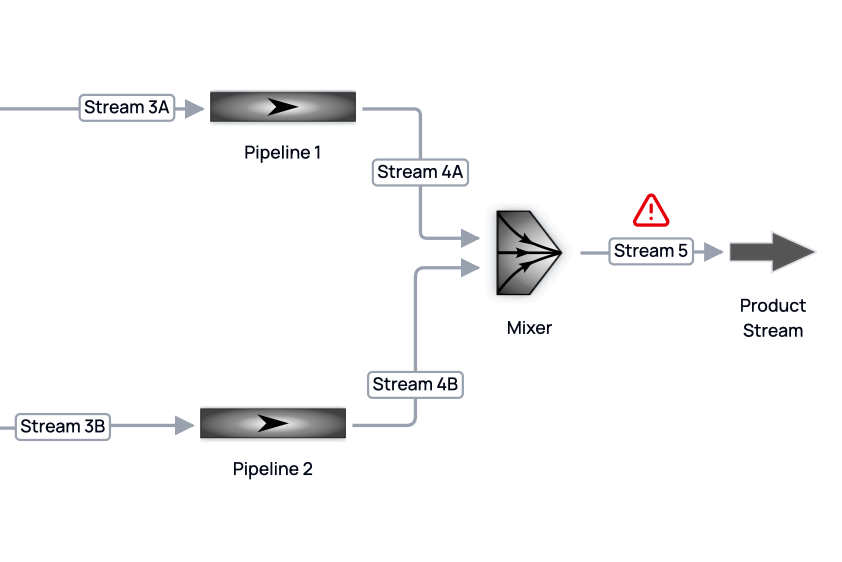
Whenever user-defined safety boundaries are violated, a red warning triangle appears next to the affected stream or process unit. In the process evaluated below, CO2 with different impurity levels is transported in two parallel pipelines. There are no risks detected before the streams are mixed at the outlets of the two pipelines. In this example, advanced, dedicated algorithms using the CPA Equation of State in combination with the van der Waals–Platteeuw model are used to identify that there is a high risk of forming hydrates at this location, as suggested by the red warning triangle.
This provides immediate, localized feedback to the engineer – not only that a safety constraint is violated, but exactly where in the process it occurs.
By highlighting the specific stream or unit that compromises the safety limits, the engineer can instantly focus on improving that part of the design by adjusting operating conditions, equipment, or process topology – without interrupting the design workflow or switching tools.
Safety verification is then no longer a separate post-processing step, but an integrated, visual part of the design process itself.

Two key differentiators
What makes the Global Safety Scan fundamentally different from traditional workflows are two core principles:
1. Purpose-specific thermodynamic models
The thermodynamic model used for mass/energy balance is not necessarily the best model for every safety phenomenon. TP-Cloud therefore evaluates them using tailored thermodynamic models selected for maximum accuracy for that specific risk (hydrates, solids, acids, etc.), while still allowing full user control through advanced settings. Examples: hydrate risk is evaluated using CPA with optimized parameters, solid CO2 is evaluated using EoS-CG combined with the most accurate dry-ice EoS.
2. Global, automated coverage
All streams and all process units are evaluated simultaneously. There is no manual selection, no checklist, and no risk of forgetting a critical location in the process.
From weeks to second without sacrificing accuracy
The result is a complete, traceable safety assessment delivered in seconds rather than weeks, with higher consistency and lower risk than any manual workflow can offer.
By eliminating stream-by-stream post-processing and removing the human factor from coverage decisions, the Global Safety Scan:
- accelerates design iterations dramatically,
- improves confidence in safety margins,
- enables safety considerations to be addressed during design, not after.
Summary
The Global Safety Scan transforms safety and flow assurance from a manual, slow and error-prone validation step into an automated, fast, and reliable design capability.
By reducing safety verification time from weeks to seconds – while applying the most accurate models available – it enables faster innovation, higher design quality, and a fundamentally safer process development workflow.