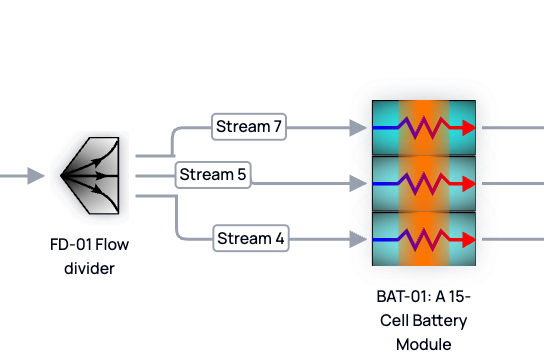
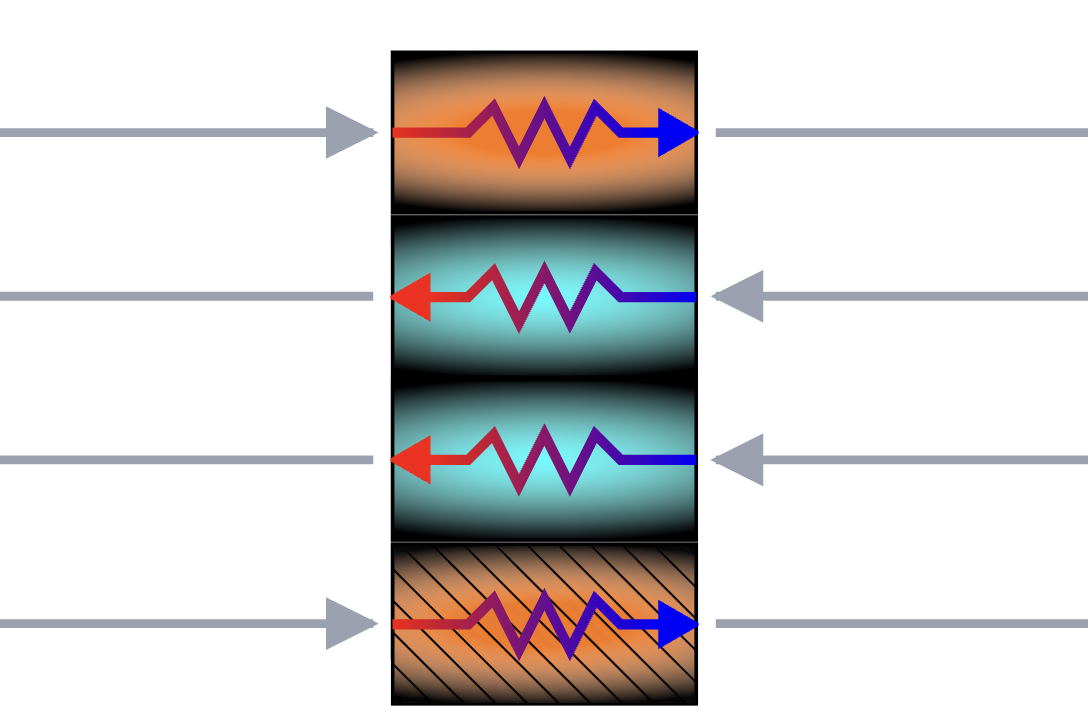
Cooling or heating an object to regulate or optimize its temperature is becoming an increasingly important challenge in emerging industries. In an electrical car, cooling of the battery if often needed. Moreover, in colder locations, like Norway at wintertime, a battery might also benefit from being heated before charging. Cooling of data centers, solar cells, fuels cells are other applications that deal with heating/cooling of an object. Let us call this object a “thermal body”.
We tried to model such systems in conventional process simulators as well as TP-Process before this summer, and found this to be very challenging, slow and frustrating. These systems were not easily represented by combining the conventional process unit models.
Hence, we decided to develop a new, dedicated process unit for this purpose called the “thermal body heat exchanger”. This process unit represents a thermal body with a temperature, which interacts with one or several fluid streams that are used for cooling, or heating purposes. The thermal body itself can represent a battery, a computer server, a solar cell, or many other practical examples. Our goal when developing the thermal body heat exchanger was to make it fast and easy to design, improve and optimize systems such as cooling of batteries, solar cells and data centers.
The example below is inspired by the experiments carried out by Xu and Wang (2023) for cooling an electric-vehicle battery module with a water-glycol mixture. The example took 5 minutes to set up, solves immediately, and allows the user to effectively iterate on improved battery configurations.
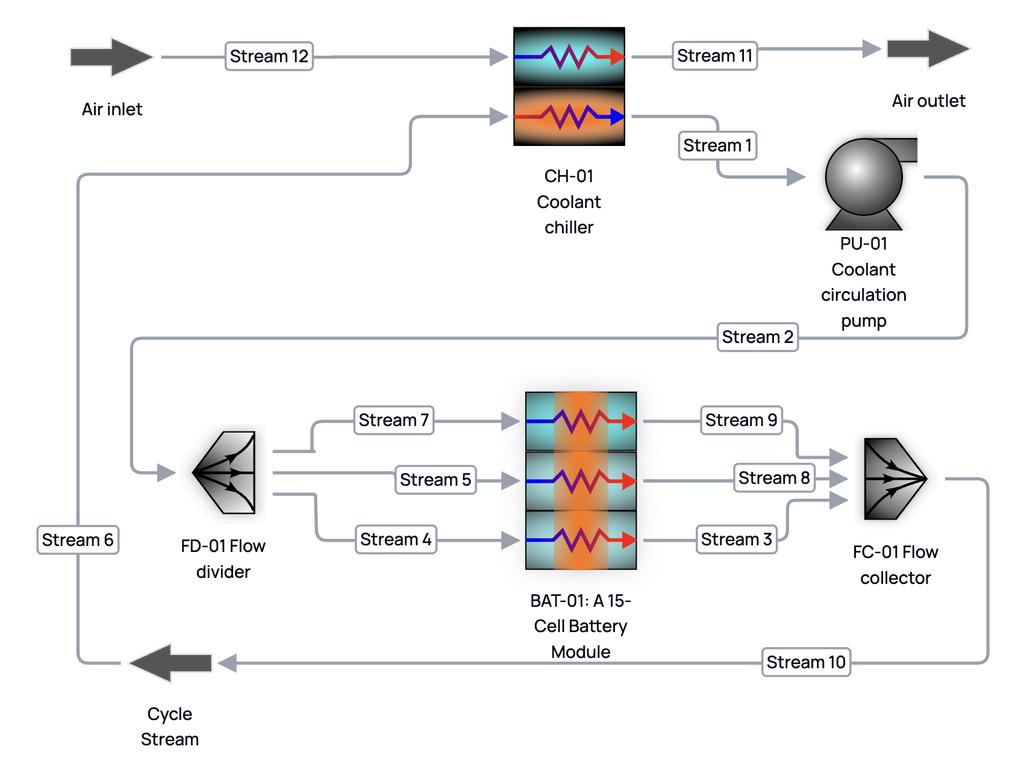
We believe that the thermal body heat exchanger in TP-Process and its use to optimize battery systems can offer many benefits, such as enhanced battery lifetime, energy efficiency, performance, safety, and engineering costs. The greatest value comes from making it possible to evaluate many cooling configurations quickly, rather than relying on expensive physical prototypes or time-consuming detailed simulations. You can explore the battery example yourself here.
Another example where the thermal body heat exchanger process unit represents a game changer is in the representation of servers in data centres. Designing data-servers, possibly with integrated waste-heat recovery, is complicated by the fact that there might be a large number of different severs, manifolds and configurations that need to be designed.
With the new thermal body heat exchanger, TP-Process is uniquely rigged for this application. In the example below, a high-density data-center is cooled in three racks, with a combined IT load of 128 kW. Each rack contains five server-representative thermal bodies cooled in parallel by a water–glycol loop, while two liquid-to-air coolant distribution units (CDUs) reject the heat to the data-center air stream. The case is inspired by the experimental system of Heydari et al. (2024) and demonstrates parallel coolant distribution, heat-generating computer severes, pumps, manifolds, CDU heat exchangers, and the coupling between server temperature, coolant flow and heat rejection. You can explore the example here.

Data centers generate an enormous amount of heat, and efficient cooling is becoming increasingly challenging as the power densities increase. Designing an optimal cooling system involves balancing cooling capacity, electricity consumption, water usage, and investment costs.
In summary
Our new process unit called the “Thermal Body Heat Exchanger”, combined with proprietary algorithms for fast and robust solution of the process simulator, enables faster development, simulation and optimization of thermal management systems for data centers, batteries, solar cells, cooling of fuel cells and many other examples.